

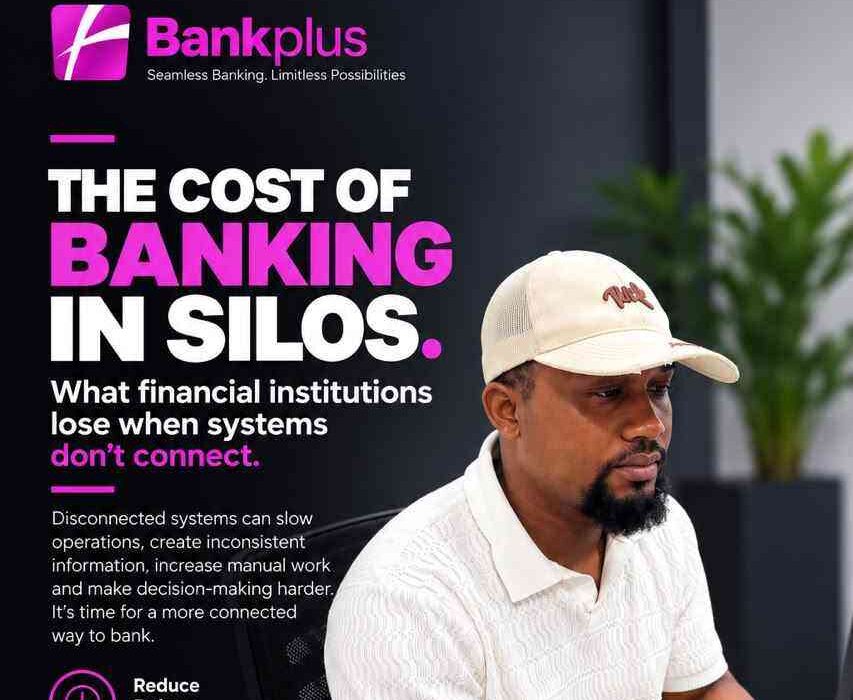
THE COST OF BANKING IN SILOS: WHAT FINANCIAL INSTITUTIONS LOSE WHEN SYSTEMS DON’T CONNECT
A financial institution can have good people, good products and a growing customer base and still struggle to operate efficiently. Sometimes, the problem is not a lack of resources. It is the fact that those resources are working in different directions. One department has one system, another department has another. Information sits in different places, staff move data from one platform to another, reports have to be compiled manually, and somewhere in the middle of all this, a simple question becomes surprisingly difficult to answer: “What is actually happening across the institution?”
This is what happens when departments, processes and systems operate independently instead of working as parts of one connected institution. The lending team may have access to information that the operations team cannot easily see. Customer information may exist in one system while transaction records sit somewhere else. Management may depend on separate reports from different departments just to understand the institution’s overall performance. Each system may appear to be doing its job, but the institution as a whole becomes harder to manage. A collection of working systems does not automatically create a working institution.
The impact becomes clearer when we consider a simple customer journey. A customer may have an account, make transactions, take a loan, contact customer service and make repayments. Each interaction creates information, but when that information is spread across disconnected systems, accessing the complete picture becomes difficult. Staff may have to search through multiple platforms, manually transfer information or wait for another team to provide the latest record. Management, meanwhile, may have to wait for different departments to submit their reports before understanding what is happening. What begins as a technology problem quickly becomes an information problem, and in financial services, information problems can become operational problems.
When systems cannot communicate effectively, people often become the bridge between them. Someone downloads the information, someone copies it into another system, someone checks the figures, someone reconciles the records, someone prepares a report, and someone reviews it again. At low transaction volumes, this may seem manageable. But as an institution grows, so does the amount of information moving through these processes: more customers, more transactions, more accounts, more loans, more staff and more reports.
The workload grows, but the process remains the same. Eventually, employees can spend valuable time moving information instead of using it. That is where the real cost of disconnected systems begins to emerge. The obvious cost is inefficiency, but the consequences can go much further, contributing to duplicate data entry, delayed reporting, inconsistent records, increased administrative workload, difficulty tracking processes, higher chances of human error, slower decision-making and poor visibility across departments.
Importantly, these problems do not necessarily happen because employees are careless. In many cases, the system simply makes the correct process unnecessarily difficult. When people have to work around technology instead of technology supporting their work, inefficiency gradually becomes part of the institution’s daily routine.
That routine can create another problem: different teams may begin working with different versions of the same information. Management might be reviewing one figure while another department is working from a different record. Both may believe their information is correct, yet someone still has to determine which figure is actually accurate. That means more checking, more calls, more emails, more reconciliation and more time spent trying to establish what should already be clear.
A connected system can help create a more consistent view of institutional information, reducing the need for departments to operate from isolated versions of reality. When everyone is working from a more connected picture, management decisions become easier because the institution has a clearer understanding of what is happening across its operations.
The effects of disconnected systems, however, do not stop inside the institution. Customers may never see the spreadsheets, internal platforms or departmental processes behind the scenes. They simply experience the outcome. If a request takes longer than expected, a staff member asks for information the institution should already have, a process requires unnecessary documentation, or a response is delayed because information has to be obtained from another department.
To the customer, it feels like poor service. Behind the scenes, the real issue may be disconnected operations. In this way, internal inefficiency eventually becomes an external experience.
The challenge becomes even greater as the institution grows. A fragmented system may appear manageable when an institution is small, but growth changes the equation. As the number of customers, transactions, products and employees increases, the amount of information moving between departments increases too. What once required five manual steps may eventually require hundreds. What once took one employee an hour may eventually consume an entire team’s time.
This is why financial institutions should not only ask whether their current systems work today. They should also ask whether the way they work will still make sense when the institution is twice as large.
Connecting systems is therefore not simply a technical exercise. It is about creating a better way for the institution to operate. When relevant information can move between processes more effectively, teams can spend less time searching, copying and reconciling. Employees can focus on their actual responsibilities, management can gain clearer visibility, processes can become easier to monitor, and customers can experience fewer unnecessary delays. The technology matters because of what it enables people to do.
This becomes particularly important because customers do not think of a financial institution as ten different departments. They think of it as one organization. If they have an account, a loan and a transaction history, they expect the institution to have a connected understanding of their relationship with it. That expectation places increasing pressure on financial institutions to move beyond isolated systems.
The goal, however, is not necessarily to have fewer systems. It is to ensure that the systems an institution depends on can work together effectively. When they do, information can move more efficiently across processes, teams can work with greater visibility, and the institution can operate with less friction.
This is the thinking behind BankPlus. BankPlus is designed to provide financial institutions with a connected environment for managing essential banking operations. Instead of treating important functions as completely separate activities, BankPlus brings core processes into a more unified operational framework. This can help institutions improve visibility, streamline workflows and reduce unnecessary movement of information between disconnected processes.
The value is not simply having another piece of technology. It is having infrastructure that helps the institution operate more like one connected organization.
That brings us back to the more important question. The question is not, “Do we have technology?” Most financial institutions do. The real questions are: Does our technology work together? Can departments access the information they need? Can management see what is happening across the institution? Can processes move from one stage to another without unnecessary manual intervention? Can the institution maintain consistency as it grows? And can employees spend more time making decisions and serving customers instead of moving information from one system to another?
These questions reveal the real cost of operating in silos. Financial institutions do not need technology simply because technology is fashionable. They need it because the complexity of modern banking demands better ways of working.
A connected institution can reduce unnecessary friction between departments, improve visibility and create a more consistent operational experience. The goal is not to eliminate every system; it is to eliminate the unnecessary walls between them.
Because when departments work separately, the institution carries the cost. But when information, processes and people work together, the entire organization becomes easier to manage.
The future of banking will not belong to institutions with the most systems. It will belong to institutions that know how to make their systems, people and information work together.