

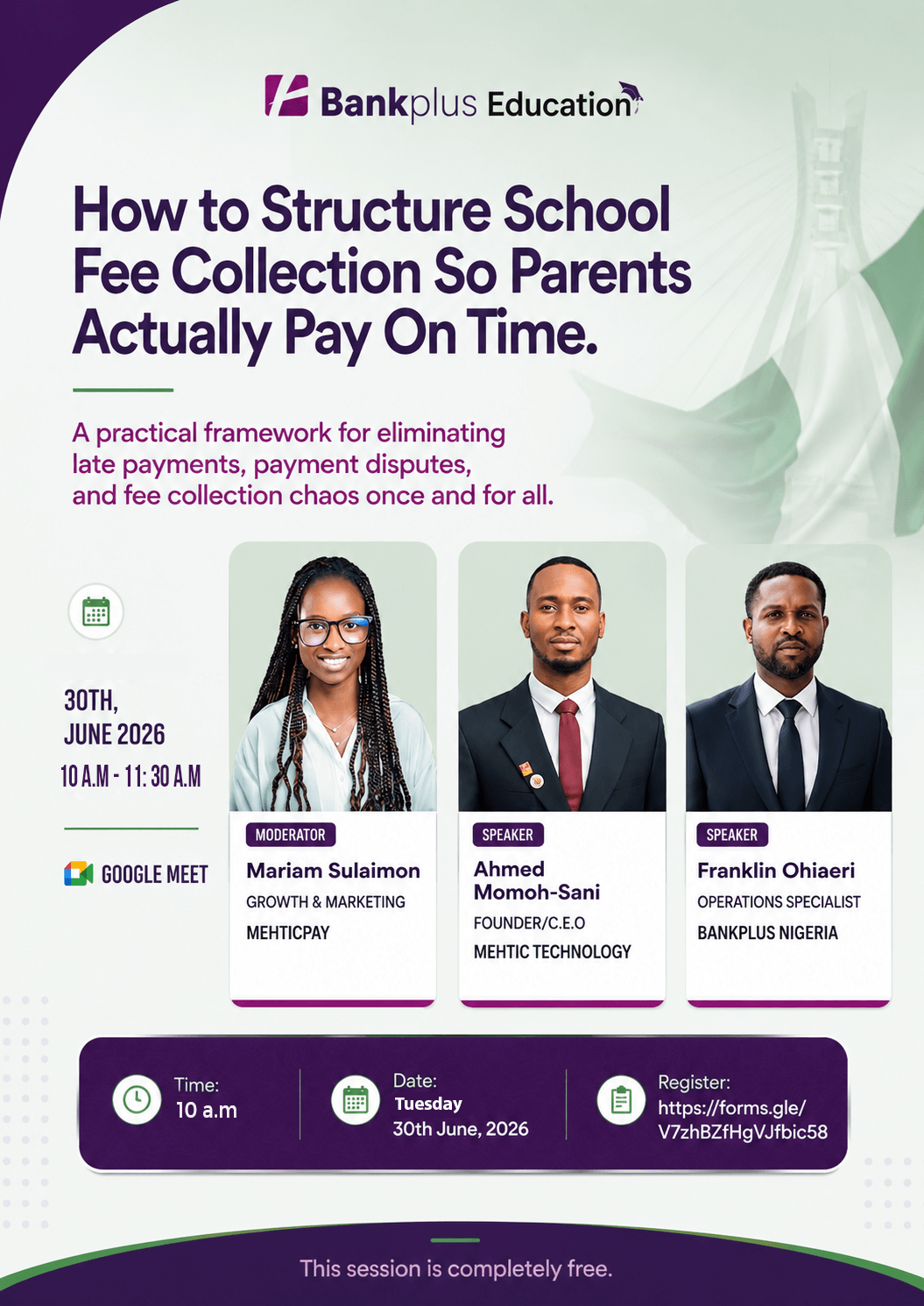
Over 40 school decision makers gathered online on June 30th for an honest, practical conversation about the financial challenges breaking Nigerian schools and what the solution looks like.
The Executive Briefing was created by Bankplus Education, a financial operating system built exclusively for Nigerian educational institutions out of one core belief:
Most Nigerian schools are not failing financially because of bad management. They are failing because they don’t have the right system to scale their educational institutions.
Over 60% of educational institutions in Nigeria deal with delayed payments from a significant portion of parents every single term. Administrative staff spend more than 40% of their time chasing fees rather than running the school. Cash flow gaps mean salaries are delayed, vendors go unpaid, and operations are disrupted, all because the fee didn’t arrive on time.
These are not isolated stories. They are sector-wide patterns. And they are entirely fixable. That is the conversation this seminar exists to have.
The Speakers🎙💥
The BankPlus 2.0 brought together three voices that, together, covered every angle of the school finance problem in Nigeria.
Franklin Ohiaeri, Operations Specialist at Bankplus Nigeria, opened the session by setting the scene. Franklin has worked hands-on with Nigerian educational institutions on their financial operations and he brought that ground-level honesty into the room immediately. His opening was an accurate truth-telling session, setting the space for the seminar.
Kabiru Usman, a Business Developer at Bankplus Nigeria. Before entering the fintech space, Kabiru spent over 14 years inside Nigerian classrooms as an educator. He has sat on both sides of this table, as someone who experienced the financial chaos firsthand, and now provides solutions to these educational institutions. The combination of his perspective gave the session a credibility that purely technical presentations rarely achieve.
Ahmed Momoh-Sani, Founder and CEO of Mehtic Technology, delivered the headline session. Ahmed has spent years building financial infrastructure for institutions across Africa, from government bodies and financial institutions to schools, real estate companies, and lending operations. He did not just present theory. He presented a tested framework for what structured school finance looks like.
The session was moderated by Mariam Oluwatimileyin Sulaimon, Growth and Marketing Lead at MehticPay.
HOW TO STRUCTURE SCHOOL FEE PAYMENT SO PARENTS ACTUALLY PAY ON TIME.
The session was structured around three core questions that every Nigerian school owner and administrator should be able to answer.
Why do Nigerian schools lose money every term without knowing it?
The answer, as Ahmed laid out clearly, is that most schools operate without a centralized financial system. Payments arrive through multiple channels with no central tracking. Receipts are issued manually and frequently lost. Revenue from books, uniforms, excursions, and other school items is barely recorded. And the school owner who is ultimately responsible, is making decisions based on estimates rather than actual data.
The result is a predictable domino chain: fee payments delay → salaries delay → vendors go unpaid → operations are disrupted → parent-school tension rises. 🚫🚫
Why do parents pay late and is it really about money?
This is the question most schools get wrong. The assumption is that parents who pay late either cannot afford to pay or do not care about their obligations. But as Kabiru Usman unpacked, the reality is more nuanced.
Late payment in Nigerian schools is driven by five structural causes: genuine financial constraints that make lump-sum payments difficult, no reminders keeping deadlines front of mind, lack of flexible payment options, unclear payment terms, and the absence of clear consequences for lateness.
These are not character flaws. They are system failures that can be fixed.
What does a properly structured school fee collection system actually look like?
The Executive Briefing presented the 5-Pillar Framework that Bankplus Education Software is built on:
Pillar 1
Clear Payment Structure and Terms: Parents need to know exactly when fees are due, what they cover, what installment options are available, and what happens if they pay late. Bankplus configures fee schedules per class, per term, and per session with automatic deadline tracking built in.
Pillar 2
Flexible Payment Options: An infrastructure built to serve both the school and parent at different levels. Installment plans, standing orders, auto-debit mandates, and multiple payment channels (bank transfer, card, USSD, QR payments etc.)
Pillar 3
Automated Reminders and Notifications: Due date reminders, payment confirmations, installment alerts, and outstanding balance notifications all handled automatically. The system chases payments so the staff don’t have to.
Pillar 4
Real-Time Visibility: A live dashboard showing exactly who has paid, who hasn’t, what was paid for, and outstanding balances by class, term, or session. See it all from one screen. Any time. On any device.
Pillar 5
Seamless Reconciliation and Reporting: Every transaction tracked automatically. Audit-ready reports available at any time. No more end-of-term reconciliation chaos.
The Questions That Ran Over Time
That is the truest measure of a session that landed. Attendees arrived with real problems and they left with real frameworks but the conversation had opened up something that wanted to keep going.
The questions covered everything from how to handle parents who have been on manual payment systems for years and resist change, to what the transition process looks like for a school moving from Excel to a fully digital system, to how the platform handles schools with multiple branches.
What Bankplus Education Software Actually Is
For those hearing about Bankplus Education Software for the first time. It is important to be clear about what this is and what it is not.
It is not a payment app. It is not a school management system in the generic sense. It is a complete financial operating system.
Every student gets a dedicated payment wallet. Every payment is tracked in real time and received digitally. Every revenue stream; fees, book sales, merchandise, and any other income` is captured in a full audit trail. Salaries are automated. Staff loans are managed within the platform. And the school owner has a real-time dashboard that shows the complete financial picture of the institution at any moment.
BankPlus Education is already live and working across different states in Nigeria. Muh’d Ibn El-Barau College of Nursing Sciences in Zaria, Kaduna was the first institution to deploy the system and the platform recently won the Startup World Cup Abuja Regional Challenge at RegTech Africa 2026, placing Bankplus Education on a global stage.
The pricing is ₦500 flat per student per term, 75% lower than what most competing platforms charge. For a school of 1,000 students, that is ₦1.5 million saved per term compared to alternatives.
The Bigger Picture
What happened in that seminar room on June 30th was not just an educational event. It was a signal.
Nigerian schools are ready for this conversation. They are ready to stop managing financial chaos and start running financially structured institutions. The BankPlus Executive Briefing Series will continue. Session 3 is coming it promises to be bigger.
If you are a school owner, bursar, board member, or administrator who missed Session 2, the full recording is available on YouTube and Facebook.
Get In Touch
Follow BankPlus on Instagram LinkedIn TikTok Facebook
📞 08050919135
📩 Email: info@mehtictech.com
This was Session 2 of the Bankplus Education School Finance Masterclass — a free ongoing seminar series designed to give Nigerian school decision makers the financial knowledge and frameworks their institutions have been missing.
About the Author
Mariam Oluwatimileyin Sulaimon is the Growth and Marketing Lead at MehticPay and the moderator of the Bankplus Education School Finance Masterclass series. She writes about financial technology, institutional growth, and education in Nigeria.